
India’s science and technology calendar has a fixed point this October. The Emerging Science, Technology & Innovation Conclave (ESTIC) 2026 runs from 27 to 29 October 2026 at Bharat Mandapam, New Delhi, with the Prime Minister opening it and three Nobel Laureates on the faculty. Thirteen ministries and departments are behind it, which tells you what the guest list looks like: secretaries and directors-general, institute heads, visiting academics, startup founders working the expo floor, and the staff who travel with all of them.
Every one of those people has to get from an aircraft or a hotel to a security-controlled venue in central Delhi, three mornings running, and then back out again. That is the part that lands on an events team, a university administrator or a company’s admin head about four weeks before the conclave — usually with the sentence “we also need cars” attached to a much larger brief.
This is a planning guide for that job: what the venue does to your timings, how Delhi’s hotel geography works against you, which vehicle suits which guest, and what to settle with a transport vendor before you sign.
ESTIC 2026
NEW DELHI · 27–29 OCTOBER 2026
Details as announced by the organisers and the Press Information Bureau for ESTIC-2026.
What ESTIC 2026 is, and who is in the room
ESTIC is the Government of India’s attempt to put its research establishment, its ministries and its startup ecosystem in one hall for three days. The 2026 edition carries the theme Creative Minds, Catalyzing Science, Empowering Technologies, tied to the Viksit Bharat 2047 agenda, and is coordinated by the Department of Scientific and Industrial Research with the Council of Scientific and Industrial Research.
The department list is the useful part for anyone planning movement, because it predicts the delegate mix: Atomic Energy, Space, Biotechnology, Science & Technology, Earth Sciences, Defence R&D, Electronics and IT, Telecommunications, Health Research, Agricultural Research, Food Processing, AYUSH and Higher Education. Add the announced faculty — Nobel Laureates Joachim Frank, Sir Richard J. Roberts and Kostya Novoselov among the international speakers — and the programme elements: plenaries, thematic sessions, a Next-Gen Discovery Expo and an Innovation Exchange Hub.
In transport terms that is four different movement patterns happening at once: protocol movement for dignitaries and international speakers, scheduled arrivals for institutional delegations, self-organised travel by hundreds of researchers, and freight-adjacent movement for exhibitors setting up stands before the doors open.
Four movement patterns, one venue
WHO IS MOVING DURING ESTIC WEEK
Why Bharat Mandapam changes how you plan the day
Bharat Mandapam sits inside the Pragati Maidan complex in central Delhi, and it is a controlled venue rather than a hotel forecourt. Three things follow from that, and all three cost time.
First, vehicle access is by designated gate and pass, not by whichever entrance is nearest your hall. Second, on an inauguration day with the Prime Minister attending, the surrounding roads work to a security plan that is published late and enforced absolutely — Mathura Road, Bhairon Marg and the tunnel approaches can all behave differently from the way your map app expects. Third, cars are not held at the door. Drop-off and pick-up are separated by a staging area, which means a guest who walks out expecting their car to be waiting at the kerb waits several minutes while it is called forward.
None of this is a problem if it is planned for. It becomes a problem when a delegation books point-to-point taxis and discovers at 09:10 on day one that the drop point is a ten-minute walk from the session hall and the driver cannot wait.
The inauguration morning is the one to over-plan
On day one, add 45 to 60 minutes to every inbound leg and move your arrival window earlier, not later. Security cordons around a Prime Ministerial inauguration change the approach roads, not just the traffic on them. The delegations that arrive calm are the ones that left the hotel before the cordon formed, with a chauffeur who already knows which gate their pass opens.
The Delhi geography problem: where guests sleep versus where they work
Central Delhi hotels sell out first for a Bharat Mandapam event, so by the time most institutional bookings are made, delegates are spread across Aerocity, south Delhi, Dwarka, Noida and Gurugram. Each of those creates a different morning.
The table below is what we plan against for a Pragati Maidan event. Treat the wider number in each range as the real one for the 08:00–10:30 inbound and the 17:00–19:30 outbound.
| From | Approx. distance | Off-peak | Peak |
|---|---|---|---|
| Lutyens’ Delhi & Connaught Place hotels | 2–5 km | 10–15 min | 15–25 min |
| IGI Airport Terminal 3 | ~16 km | 30–40 min | 50–80 min |
| Aerocity hotel cluster | ~14 km | 30–40 min | 45–75 min |
| South Delhi (Saket, Vasant Kunj) | 15–20 km | 35–45 min | 60–90 min |
| Noida (Sector 18, Sector 62) | 15–25 km | 35–45 min | 60–95 min |
| Gurugram (Cyber City, Golf Course Road) | 28–35 km | 55–70 min | 90–130 min |
Indicative planning ranges from our own Delhi NCR runs, not map estimates. Inauguration-day cordons sit on top of these.
The practical conclusion: if your delegation is staying in Gurugram and your session starts at 09:30, the car leaves at 07:30. If that sounds excessive, it is the difference between a delegate walking into a plenary and a delegate watching it on a screen in the corridor.
Which vehicle for which guest
Vehicle class is a protocol decision before it is a comfort decision. For a conclave with ministers, institute directors and international faculty in the same building, the allocation usually looks like this.
| Who is travelling | Vehicle | Why |
|---|---|---|
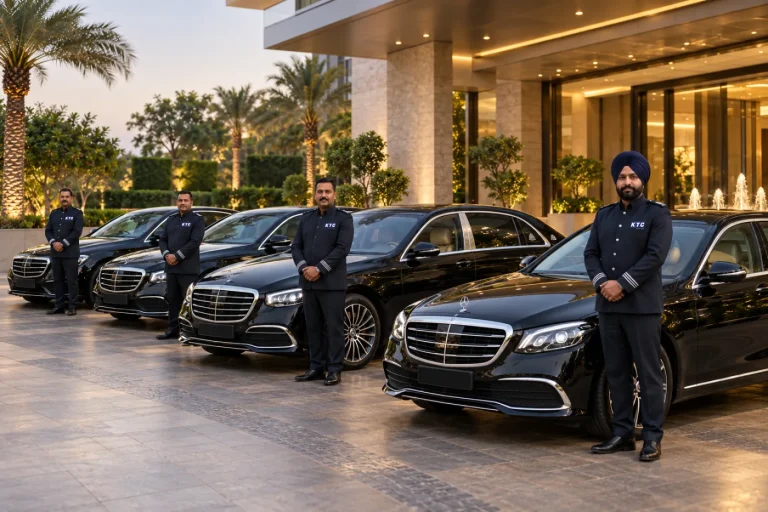
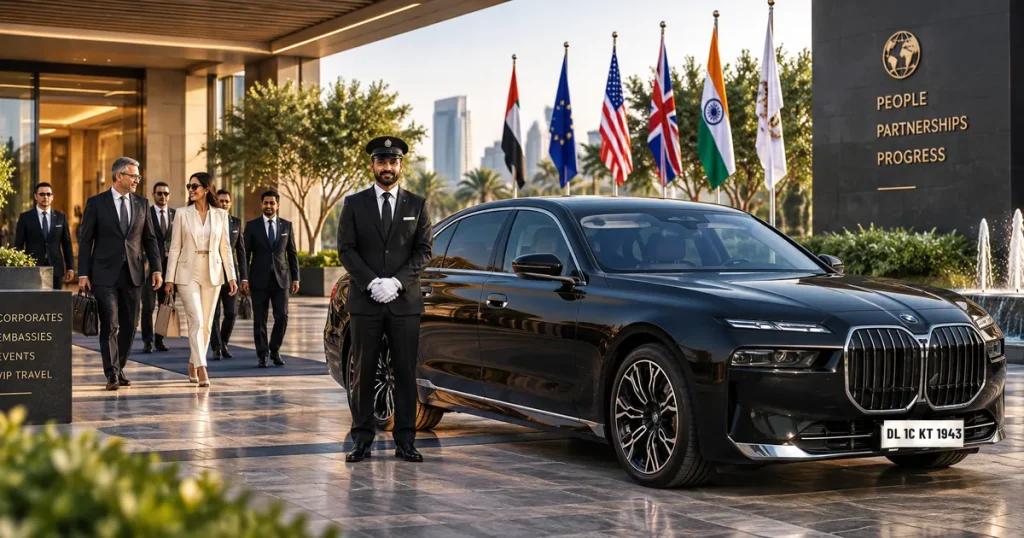
| Chief guests, Nobel faculty, heads of delegation | Mercedes S-Class, BMW 7 Series | Protocol-appropriate, quiet enough to take a call, fixed car for the full visit |
| Secretaries, directors, senior speakers | Mercedes E-Class, Toyota Camry | Executive class without the convoy footprint |
| Session panels and faculty pairs | Mercedes V-Class, Toyota Vellfire | Four people can prepare together between venues |
| Institutional teams and researchers | Toyota Innova Crysta | The workhorse for six to seven with cabin bags |
| Exhibitor and stand crews | Force Urbania, tempo travellers | Crew plus equipment, early bump-in and late strike hours |
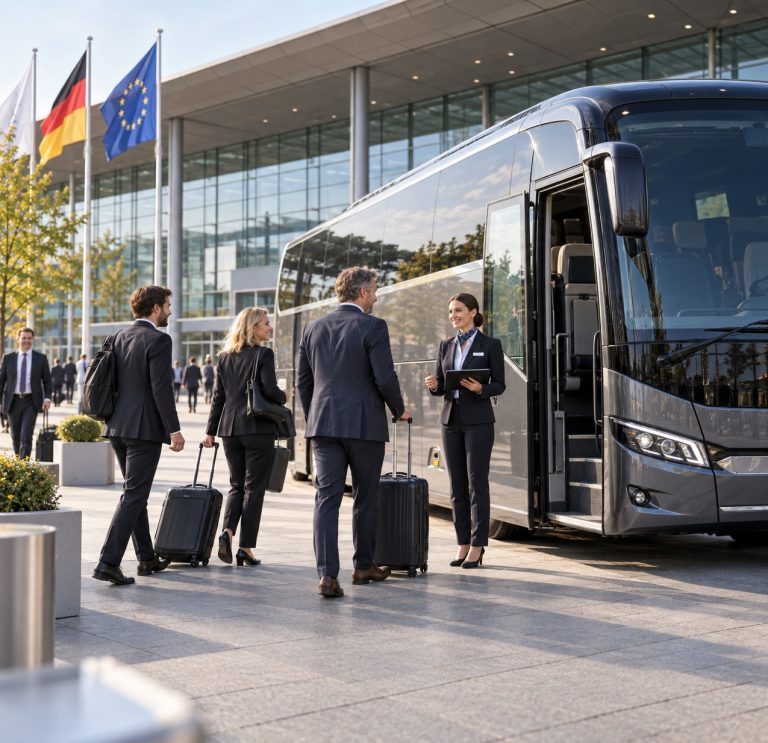
| Student groups, press pools, shuttles | Volvo coaches, commuter buses | Moves 30–49 people on one pass instead of a car queue at the gate |
| Sustainability-led programmes | Electric vehicles | Real EVs on the roster when the event wants them, with charging planned |
How the week actually runs
A three-day conclave is a nine-day transport job. The visible part is 27–29 October; the work that makes those three days uneventful happens before and after.
Requirement lock
Delegate list, arrival windows, vehicle classes and pass requirements are fixed. Late additions cost more than early over-booking.
Route recce at the real hour
Hotel-to-venue legs are driven at 08:30, not at noon, and gate access is confirmed against the passes actually issued.
Exhibitor bump-in
Stand crews and equipment move before the public programme starts, often outside normal hours.
Inauguration day
Earliest departures, tightest cordons, most standby vehicles. Everything else in the week is easier than this morning.
Session shuttling
Continuous hotel–venue–side event movement, with cars on standby between legs rather than released.
Phased outbound
Airport runs staggered across the evening and the following morning, with fog-season buffers once late October sets in.
What to settle before you sign a transport vendor
Most event transport goes wrong in ways that were predictable at the contract stage. These are the questions worth asking while you still have a choice of supplier.
Settle this in writing
- Whether the vehicles are owned by the operator or brokered on the day
- Standby vehicles and standby chauffeurs, costed in from the start
- Named chauffeur locked to a named car for the whole conclave
- Who holds venue passes and who parks where
- A control room number that is answered at 06:00 and at midnight
- Waiting time, night hours and outstation rules, written down
What it looks like when you do not
- A different car and a different driver on day two
- No spare vehicle when one is stuck behind a cordon
- A driver who has never approached the venue gate before
- Schedule changes that reach half the fleet
- Guests waiting at the wrong gate in the dark
- An invoice with hours nobody agreed to
Where KTC India fits
We have been running ground transport out of Delhi since 1943, and central-Delhi summit weeks are a normal part of the year rather than a special project. Most recently we deployed more than 300 vehicles for delegations visiting the BRICS Summit at the same venue — you can read how that fleet was run — and we hold long-standing contracts for corporate and institutional movement across the NCR.
Owning the fleet is what makes a surge possible; brokered fleets cannot absorb a late schedule change.
For ESTIC week specifically, the useful services are event and conference transport, airport transfers for phased arrivals, coaches for shuttle loops, and chauffeur-driven cars in Delhi for the people who need a car held for them all day.
Booking, lead time and what it costs
Book early. Central Delhi in late October already carries wedding-season and conference demand, and the premium classes — S-Class, 7 Series, V-Class, Vellfire — are the first to be committed. Three to four weeks out is comfortable for a mixed fleet; the week before is when substitutions start.
As a benchmark, chauffeur-driven luxury cars start at ₹15,000 + GST for a 4-hour / 40 km package, with executive sedans, Innova Crysta, Urbania and coaches priced below that on the same structure. Full-day event packages, multi-day delegation rates and standby vehicles are quoted against the actual run sheet rather than a list price, because an event fleet is priced on standby hours as much as on distance.
If you are putting an ESTIC 2026 requirement together, send us the delegate count, the hotels and the session timings — that is enough for a costed run sheet. Our reservations desk works 24×7 on +91 11 4258 8888, or use the enquiry form.
Frequently asked questions
When and where is ESTIC 2026 being held?
ESTIC 2026 runs from 27 to 29 October 2026 at Bharat Mandapam, Pragati Maidan, New Delhi. The Prime Minister is scheduled to inaugurate it on 27 October.
How far is Bharat Mandapam from Delhi airport?
Terminal 3 at IGI Airport is roughly 16 km from Bharat Mandapam. Allow 30 to 40 minutes off-peak and 50 to 80 minutes in the morning and evening peaks, with more on the inauguration morning when security cordons are in place.
Can you provide cars for the full three days rather than point to point?
Yes. Most conclave requirements are run as full-day packages with the car and chauffeur held for the delegate, because the value is in the car being there between sessions, not in a single transfer.
Do you handle exhibitor and stand crew movement as well as delegates?
Yes. Bump-in and strike hours fall outside the public programme, so crew vehicles such as Urbania and tempo travellers are scheduled separately from delegate cars.
How many vehicles can you deploy for one event in Delhi?
We deployed over 300 vehicles for BRICS Summit delegations at the same venue in 2026, and we run more than 200 vehicles on duty on an ordinary working day, so conclave-scale requirements are within normal operating range.
How far in advance should event transport be booked?
Three to four weeks for a mixed fleet in late October. Premium sedans and people movers commit earliest; coaches and crew vehicles hold availability slightly longer.
Do you provide transport for international delegations arriving for the conclave?
Yes, including airport reception, multi-day chauffeur allocation and protocol-aware vehicle classes. We move diplomatic and institutional delegations in Delhi through the year, not only during summit weeks.