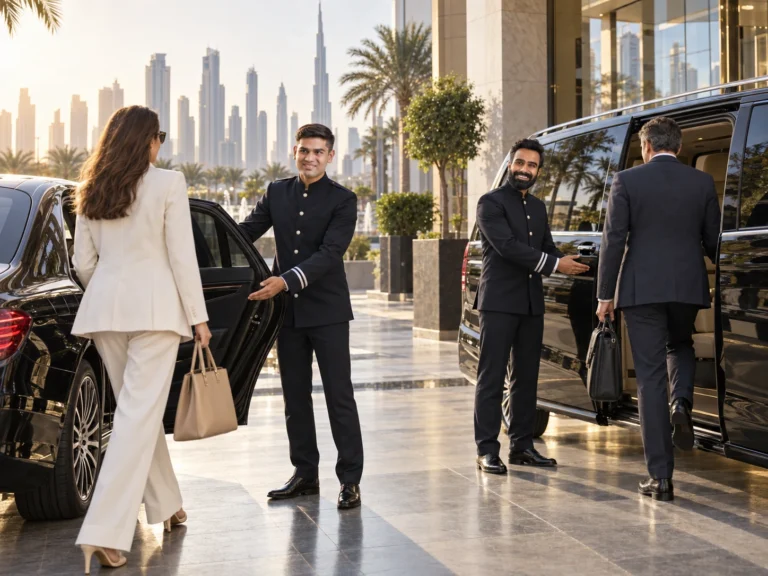

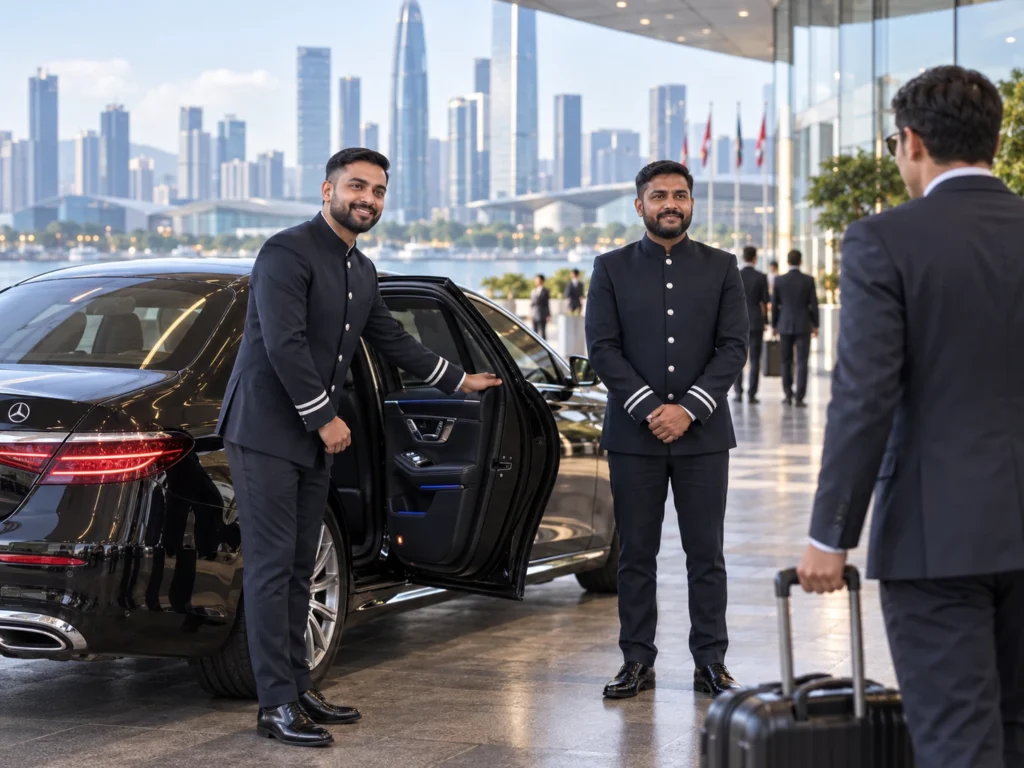
Shenzhen hosts the 33rd APEC Economic Leaders’ Meeting on 18 and 19 November 2026, with the APEC CEO Summit running immediately before it on 17 and 18 November. For the companies sending executives — and for the delegations, trade bodies, suppliers and media travelling alongside them — the hard part of the week is rarely the agenda. It is moving people between an airport, a hotel and a secured venue in a city of more than 17 million, across days when parts of the road network will be closed at short notice.
This is a planning guide for that problem: how people actually get into Shenzhen, what the Hong Kong border does to a vehicle plan, which class of car suits which guest, and what to settle with a ground transport supplier before the first flight lands.
33rd APEC Economic Leaders’ Meeting
SHENZHEN · 18–19 NOVEMBER 2026
Dates and theme as announced by the host economy. The precise venue for the Leaders’ Meeting had not been published at the time of writing — plan for both the Futian and Bao’an clusters until it is.
What APEC week looks like from the kerb
An APEC host city does two things at once. It runs a tightly controlled leaders’ programme behind a security cordon, and it hosts a much larger commercial week around it — the CEO Summit, business council sessions, bilateral meetings in hotel suites, and a great deal of private hospitality. The first has fixed routes and official vehicles. The second is where most business travellers actually sit, and it runs on ordinary cars moving through a city whose traffic has been rearranged.
The practical consequence: your executives will spend more time in a vehicle than the schedule suggests, and the variability is on the inbound legs, not the outbound ones. Plans that work are built around arrival windows and cordon timings rather than around a neat hotel-to-venue shuttle loop.
Four ways into Shenzhen, and why the choice changes your day
Shenzhen has its own international airport, but it also sits inside a cluster with two much larger ones. Which you route through is a scheduling decision as much as a fares decision, because one of the options puts an international border between your guest and their hotel.
| From | Approx. distance | Off-peak | APEC week, allow |
|---|---|---|---|
| Shenzhen Bao’an Intl (SZX) → Futian CBD | ~32 km | 40–50 min | 60–90 min |
| Shenzhen Bao’an Intl (SZX) → Nanshan / Shekou | ~25 km | 30–40 min | 50–75 min |
| Hong Kong Intl (HKG) → Futian, via Shenzhen Bay | ~55 km + border | 1 hr 45 | 2 hr 30 – 3 hr 30 |
| Guangzhou Baiyun (CAN) → Shenzhen | ~130 km | 1 hr 45 | 2 hr 30 – 3 hr |
| Futian CBD → Bao’an convention district | ~30 km | 35–45 min | 60–80 min |
| Hotel cluster → venue, inside the cordon | 2–8 km | 10–20 min | 30–60 min |
Road distances and typical durations, not guarantees. Summit-week figures assume rolling closures and checkpoint queues on the approach roads.
The Hong Kong border is a vehicle problem, not a passport problem
Routing a guest through Hong Kong International is often the easiest flight to book and the most commonly underestimated transfer. The visas and permits are usually straightforward for business travellers. The vehicle is not.
A car cannot simply drive from Hong Kong to Shenzhen
Vehicles crossing between Hong Kong and the mainland need cross-boundary authorisation and dual number plates, and the quota for them is limited. Most executive transfers therefore change vehicle at the border: a Hong Kong car to the control point at Shenzhen Bay, Futian, Huanggang or Liantang; foot passage through immigration; a mainland car waiting on the other side. Build that handover into the timeline as a real step with a named contact on each side, or it becomes the moment the day slips.
If continuity matters more than flight convenience — a principal who should not be walking a border hall with baggage — fly into Shenzhen Bao’an directly and accept the longer air leg. If the flight into Hong Kong is unavoidable, book the crossing as its own segment and allow for peak queues at the control points, which lengthen considerably in a summit week.
Which vehicle for which guest
Most delegations over-specify the principal’s car and under-specify everything behind it. The second and third vehicles are where a week is won or lost, because that is where the advance team, the interpreters, the documents and the luggage actually travel.
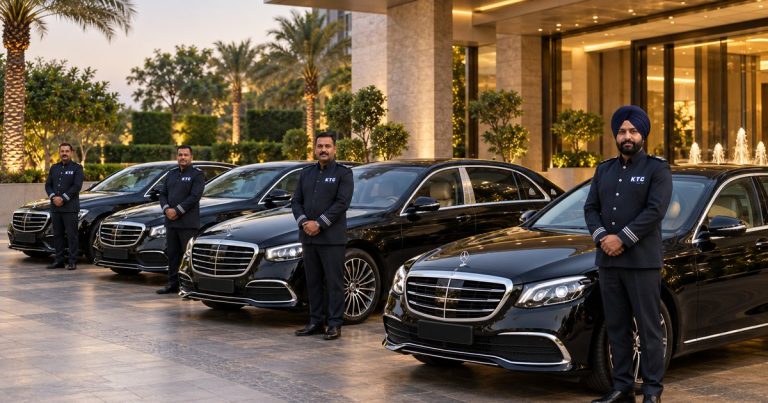
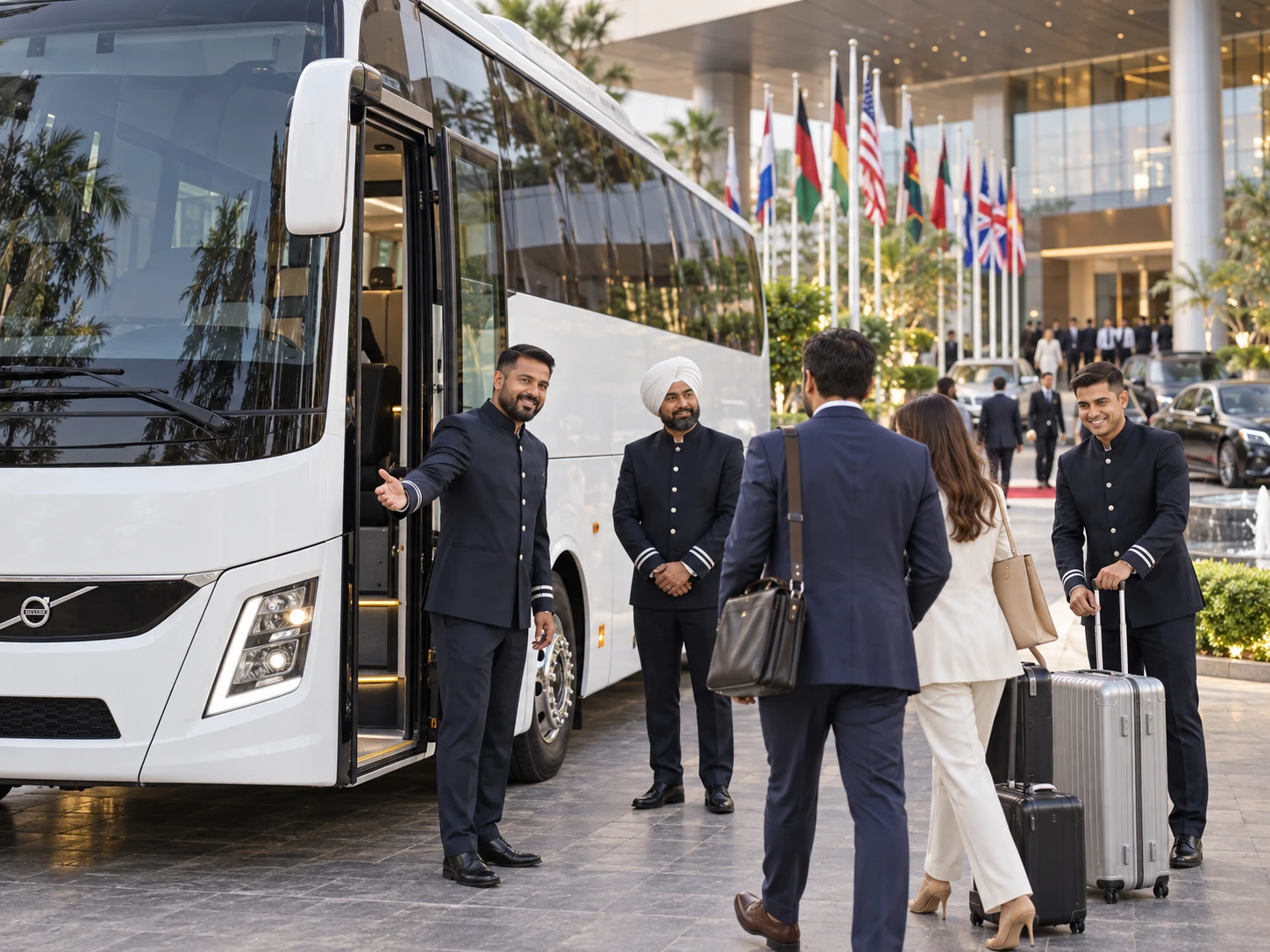
KTC operates these classes as a single owned fleet rather than a brokered list, which is what makes a late change absorbable. If you want to see the categories in detail, the KTC fleet pages set out each class, and the luxury vans and coaches and commuters pages cover the group end of the requirement.
How an APEC week actually runs
Lock the requirement
Names, arrival windows, vehicle classes, interpreter seats and any accreditation the venue requires. In a cordoned city, late additions are not a pricing problem — they are an access problem.
Confirm the border plan
If anyone is routing through Hong Kong, fix the control point, the handover contact and the mainland vehicle now. Quota-limited cross-boundary vehicles cannot be arranged on the day.
Drive the routes at the real hour
An 08:30 hotel-to-venue leg is a different road from the same leg at noon. Recce at the hour the movement will happen, and record the alternates.
Advance teams and equipment
Technical crews, stand builders and delegation staff move before the principals do, usually outside normal hours and often to a different address.
Hold the fleet, do not release it
Sessions overrun, bilaterals are added and hospitality shifts. Vehicles held on standby cost less than vehicles recalled across a cordon.
The compressed wave
Most of a summit leaves inside the same twelve hours. Stagger departures deliberately and add a buffer at the airport end, where the queues are.
What to settle before you sign a transport vendor
Get this in writing
- Whether the vehicles are owned by the operator or brokered on the day
- Standby cars and standby chauffeurs, priced in from the start
- A named chauffeur locked to a named vehicle for the whole week
- Who holds venue access and where vehicles stage between movements
- The border handover plan, with a contact on each side
- A control room number answered at 05:00 and at midnight
- Waiting time, night hours and cross-city rules, written down
What it looks like when you do not
- A different car and a different driver every morning
- No vehicle when a session overruns by forty minutes
- A chauffeur who cannot reach the gate your pass opens
- Luggage arriving separately from the people who own it
- A border handover discovered at the border
- An invoice with charges nobody agreed in advance
Where KTC India fits
KTC has moved delegations for the kind of week APEC creates — most recently more than 300 vehicles for delegations from ten countries at the BRICS Summit 2026, alongside ICC cricket tournaments, Formula 1 and World Para Athletics. The operating model is the same wherever the movement happens: an owned fleet, vetted chauffeurs, a single point of contact and a control room that answers.
Owning the fleet is what makes a surge possible. A brokered fleet cannot absorb a schedule that changes on the morning.
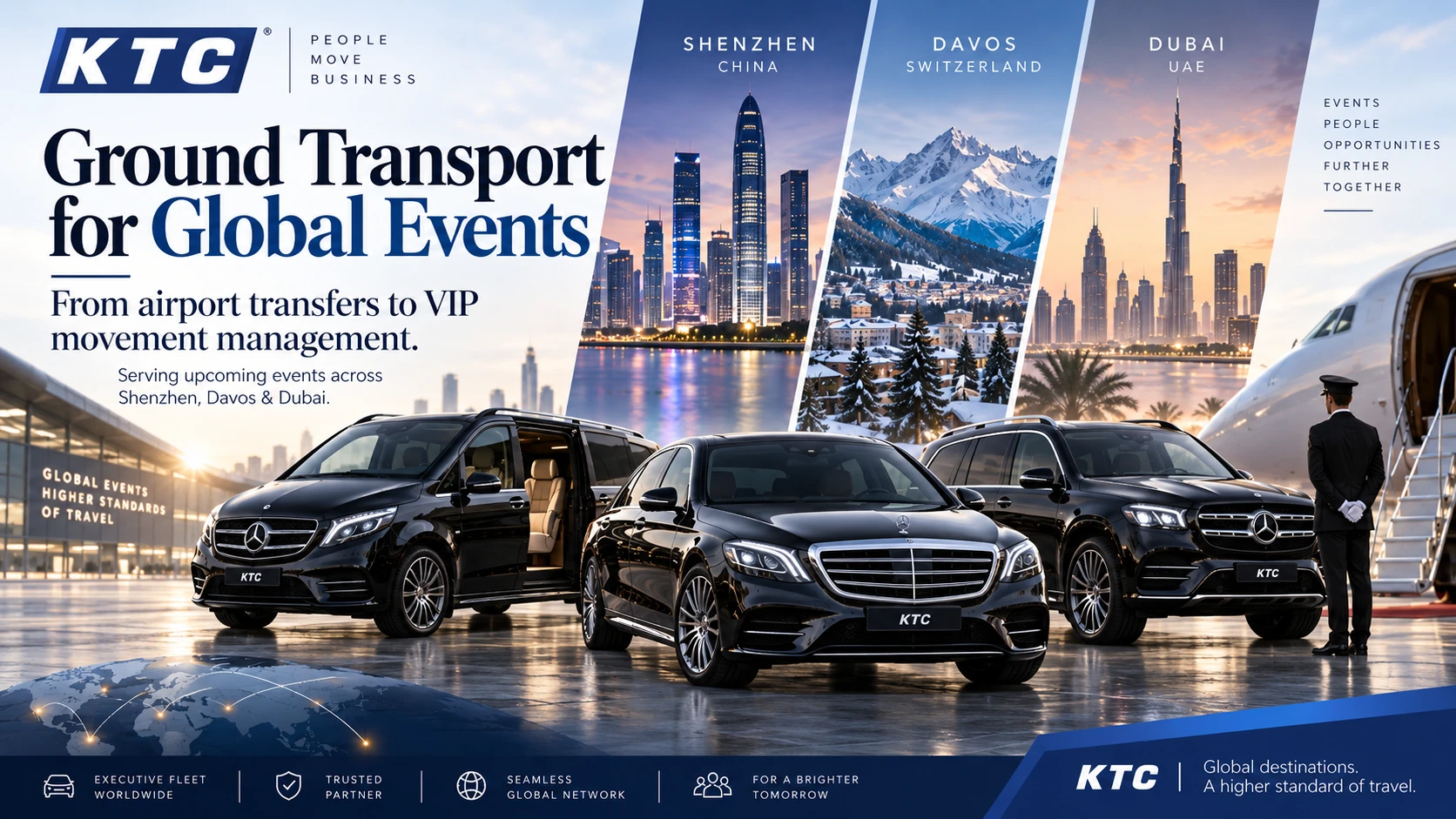
For APEC week the relevant services are VIP and delegation ground transport, event and conference transportation and airport transfers. For the region, see luxury car rental across Asia and the wider global presence map. If your executives are travelling on from Shenzhen to Davos or Dubai, the companion guides cover WEF Davos 2027 and the World Governments Summit 2027.
Frequently asked questions
When and where is the APEC 2026 Leaders’ Meeting?
The 33rd APEC Economic Leaders’ Meeting takes place on 18 and 19 November 2026 in Shenzhen, Guangdong Province, China. The APEC CEO Summit runs in the same city on 17 and 18 November, so most business travellers are on the ground from around 16 November.
Can I book a car in Shenzhen through KTC India?
Yes. KTC coordinates ground transport for clients travelling to events across 40-plus countries, using the same single point of contact, vetted chauffeurs and reporting standards applied at home. Tell us the arrival windows and the vehicle classes and we will build the movement plan around them.
Should I fly into Shenzhen or Hong Kong?
Fly into Shenzhen Bao’an if vehicle continuity matters, because a car can meet the aircraft and stay with the guest all week. Hong Kong often has better long-haul connections, but a vehicle cannot simply drive across the boundary without cross-boundary authorisation and dual plates, so plan for a change of vehicle at the control point and add two to three hours door to door.
How far in advance should APEC transport be booked?
Thirty days for anything involving accreditation, cross-boundary movement or more than a handful of vehicles. Summit weeks exhaust the premium supply in a host city early, and access arrangements cannot be made retrospectively.
What vehicles do you provide for delegations?
Executive sedans, premium SUVs, luxury vans, minibuses and full-size coaches, drawn from a fleet of more than 2,500 owned vehicles. Most delegations run a mix: a sedan for the principal, a van for the working group and a coach for the wider party.
Do you provide chauffeurs who speak English?
Yes. English-speaking chauffeurs are standard for international delegation work, and interpreters can be arranged separately where a language other than English is needed for the working sessions.
Can you handle a schedule that changes during the week?
That is the reason to hold standby vehicles rather than release the fleet between movements. Sessions overrun and bilaterals appear at short notice; vehicles already staged nearby absorb that, whereas vehicles recalled across a security cordon do not.