

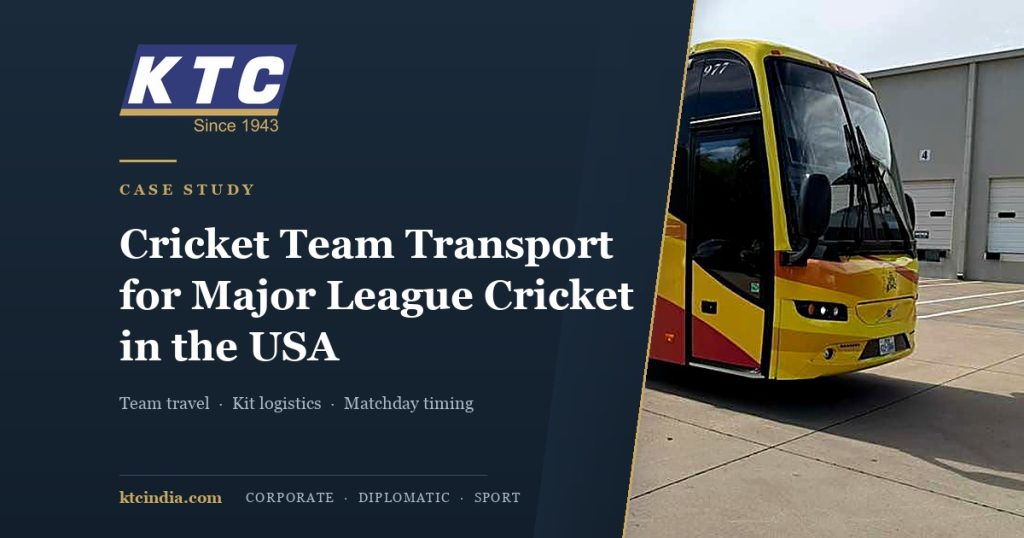
A T20 franchise season looks, from the outside, like a series of matches. From a transport desk it looks like something else entirely: a squad of players, coaching staff, physios, analysts and support crew who have to arrive together, on time, rested, with their kit intact, at grounds and hotels spread across a country the size of a continent. When KTC supplied coaches for Major League Cricket in the United States, that was the brief. Not vehicles. Movement.
This is a look at what team transport for a professional cricket franchise actually involves, and why the same operating model KTC uses for summit and delegation work transfers cleanly to elite sport.
Major League Cricket, and why it changed the transport question
Major League Cricket launched in 2023 as the United States’ franchise T20 competition, with teams anchored in Dallas, New York, Seattle, Los Angeles, San Francisco and Washington. Several franchises carry the DNA of established international sides, which brings with it an expectation of how a professional squad is looked after on the road.
That expectation is the point. A league can be new, but the standard of a team bus cannot be. Players arriving for a televised fixture have to step off a vehicle that is clean, quiet, climate controlled and on schedule, in front of cameras and supporters. The coach is part of the matchday product.
The brief: what franchise cricket transport actually requires
Team movement is not a coach booking with a start and end point. Across a season the requirement typically covers:
- Squad transfers between team hotel and stadium on training days and matchdays, often twice in a day
- Airport runs for arriving and departing players, who rarely all travel on the same flight
- Separate movement for coaching, analysis, medical and media staff, whose schedules do not match the players’
- Kit and equipment transport, which is bulky, valuable and cannot be delayed
- Sponsor, broadcast and guest movement around fixtures
- Contingency vehicles held on standby for schedule changes, weather calls and overruns
Each of those is straightforward on its own. Run together, over a compressed season, with fixed broadcast start times, they become a scheduling problem. That is the same problem KTC solves for conferences and large events, where hundreds of movements have to resolve to one timetable.
The fleet: touring coaches built for a professional squad
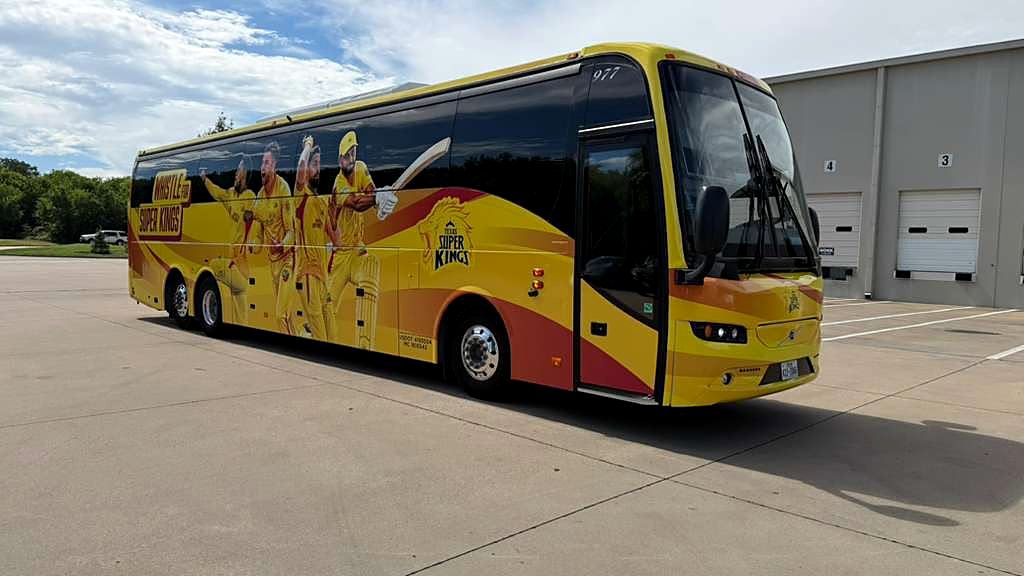
The vehicle used for the franchise was a full-size Volvo touring coach, the class of vehicle built for long-distance travel rather than short shuttle work. For a cricket squad, the specification matters in ways that are easy to miss:
- Seat pitch and recline. Fast bowlers and tall batters do not fold into commuter seating. Touring configuration gives real legroom.
- Luggage capacity. Cricket kit is unusually bulky. Coffins, bat bags, keeping gear and training equipment need underfloor bays, not an overhead rack.
- Climate control. A Texas summer is punishing. Cabin temperature on the way to a ground is a performance issue, not a comfort one.
- Ride quality and noise. Players sleep, review footage and prepare on board. A quiet cabin is part of the preparation.
- Power and connectivity. Analysts work in transit. Charging at the seat is not optional.
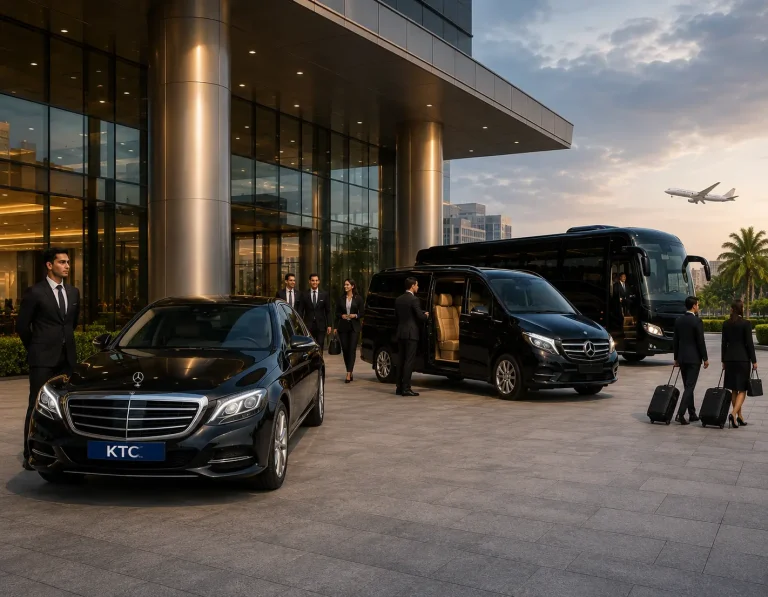
Where a squad splits, smaller vehicles carry the overflow. KTC uses Mercedes-Benz Sprinters and luxury mini vans for exactly this: staff groups, late arrivals and equipment runs that do not justify a full coach.
Livery: when the team bus becomes the brand
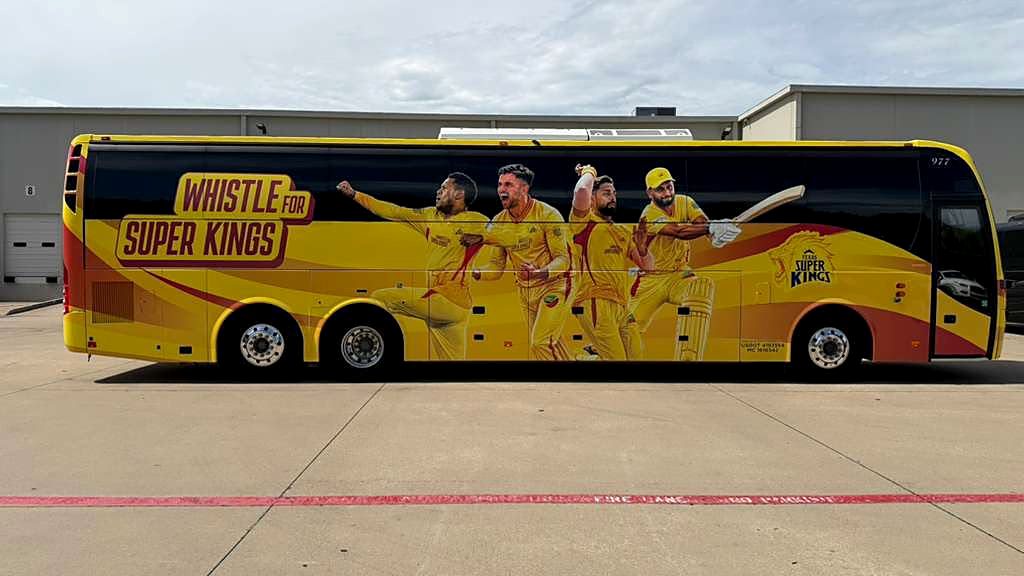
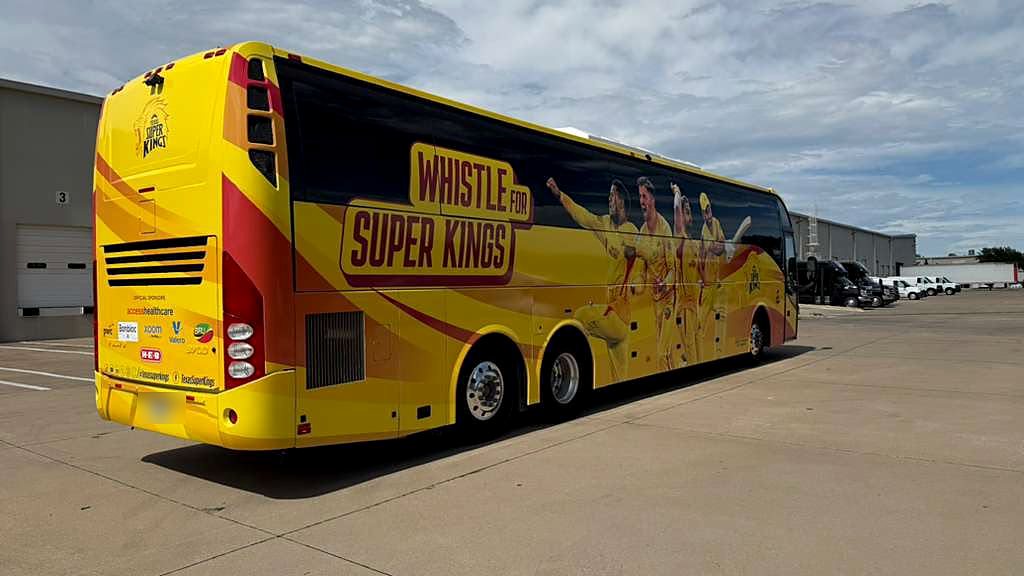
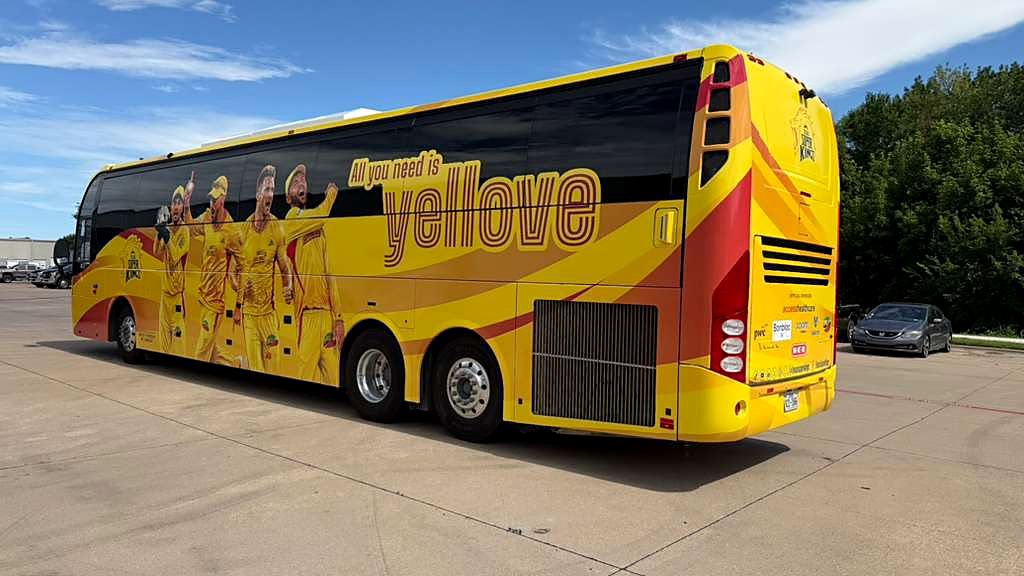
The franchise coach carried a full wrap, front to back, in team colours, with player imagery and the slogans supporters already know. It is worth being clear about what that achieves. A wrapped team coach is a moving billboard that appears in fan photographs, arrival footage, broadcast cutaways and social media without anyone buying media space for it.
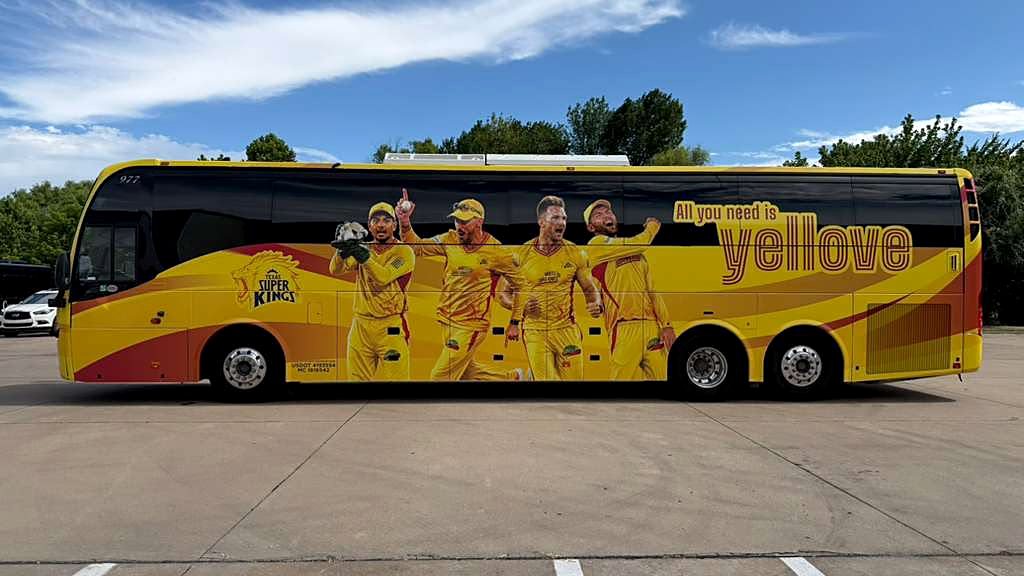
Delivering that reliably has practical consequences for the transport operator. The same vehicle has to be held for the season, because a wrap cannot follow a substitute bus. Wash and presentation standards go up, because a dirty branded coach is worse than an unbranded one. And the vehicle has to be parked and staged where the arrival shot works, which is a conversation with the venue, not just the driver.
Matchday choreography
On a matchday the coach does not simply arrive. It arrives into a sequence. Broadcast has a window for the team arrival. Security has an approved route into the venue and a designated set-down point. The ground has other vehicles doing the same thing at the same time.
KTC’s approach here is the one it applies to state visits and multilateral summits: agree the movement order in advance, brief the chauffeur on the route and the set-down, and give the team manager one named coordinator to call rather than a switchboard. When a warm-up overruns or rain moves a start time, the change is made once, centrally, and every vehicle is told.
Kit, equipment and the things people forget
Cricket travels heavy. A squad’s equipment is expensive, awkward to load and, in a compressed season, effectively irreplaceable at short notice. Practically, this means allowing loading time in the schedule rather than assuming it, keeping the same crew across the season so loading becomes routine, and making sure the vehicle held on standby has equivalent luggage capacity. A backup coach that cannot take the kit is not a backup.
Why franchises consolidate to a single operator
The alternative to a managed arrangement is contracting locally in each city: a different supplier per venue, different standards, different invoices and no single point of accountability when something slips. For a short tour that is survivable. Across a season it is not.
A consolidated arrangement gives the franchise one contract, one service standard, one escalation path and one set of reporting. It is the same argument that drives corporate mobility programmes and employee transport contracts, applied to a sporting calendar.
Delivering outside India
KTC is an Indian operator with a self-owned fleet at home, and delivers ground transport across the United States through its partner network. Outside India, including across North America, work is delivered through a vetted partner network under KTC’s brief and service standard, with KTC holding the client relationship and the accountability. The franchise deals with KTC. KTC deals with everything else.
That model is what allows a single team to be looked after consistently whether the fixture is in India, the United States or anywhere else in KTC’s global network, and it is the same structure described in our case study on ground mobility for a Belgian economic mission to the USA.
Cricket and sport are not new ground for KTC
Sport has been part of KTC’s work for years, alongside the summit and state-visit programmes it is better known for. The operating requirements overlap almost exactly: fixed timings that cannot move, squads that travel as a unit, security and accreditation layers, heavy equipment, and a public arrival that is part of the event itself.
Eighty years of operating history, described in our story, sits behind that, along with the organisations KTC works with and the national tourism awards the company has received.
Planning a season? Start earlier than you think
The single most useful thing a franchise, federation or touring side can do is engage a transport partner at fixture-release stage rather than at travel-booking stage. Early engagement is what makes it possible to hold a dedicated wrapped vehicle for the season, secure the same crew throughout, walk the venue set-down points before the first fixture, and build contingency into the plan instead of improvising it.
If you are planning team movement for a league season, a tour or a tournament, talk to KTC’s team about a managed plan. For the vehicles themselves, see our sports team transportation service, our coach and bus fleet and mobility solutions.
Frequently asked questions
Does KTC provide team transport outside India?
Yes. KTC delivers international team and delegation transport through a vetted partner network, managed to KTC’s own brief and service standard. The client keeps one relationship and one point of escalation instead of contracting separately in every host city.
What size vehicle does a professional cricket squad need?
A full-size touring coach is the usual answer for the playing squad, because it combines proper seat pitch with the underfloor luggage capacity that cricket kit demands. Staff groups, late arrivals and equipment runs are normally handled by smaller vehicles such as Sprinters or mini vans running alongside the main coach.
Can a team coach be branded in franchise livery?
Yes, and for a league season it is common. A full wrap does mean the vehicle must be dedicated to the team for the whole period rather than rotated, and presentation standards have to be maintained throughout, so it needs to be agreed at planning stage rather than added later.
How far in advance should team transport be booked?
As close to fixture release as possible. Early engagement is what secures a dedicated vehicle, consistent crew and rehearsed venue access. Late bookings can still be fulfilled, but the dedicated wrapped coach and the same-crew continuity are the first things to become unavailable.
Who handles matchday coordination?
A named KTC coordinator owns the movement plan and is the single contact for the team manager. Route, set-down point and arrival timing are agreed with the venue and broadcast in advance, and any change during the day is issued centrally to every vehicle.
Does KTC handle equipment and kit separately from players?
It depends on the volume. Most squads travel with kit in the coach’s underfloor bays. Where equipment exceeds that, or where kit has to move to a venue ahead of the squad, a separate vehicle is scheduled for it so the player movement is never held up by loading.
Related reading
 Company NewsVIP Delegation Transport in Practice: Ground Mobility for a Belgian Economic Mission to the USA21 Aug 2026
 Industry InsightsWhy Fortune 500 Companies, HNIs & Mega Events Trust KTC for Ground Transportation1 Aug 2025
 BlogGround Mobility Services for Employee Transportation, VIP Travel, and Business Events30 Jul 2026